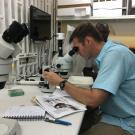
Congratulations are due to Dr. Brian H. Bird, co-principal investigator for the Defense Advanced Research Project Agency (DARP)-funded Preventing Emerging Pandemic Threats (PREEMPT) project, as well as lead for Ebola-related surveillance activities as part of the USAID-funded PREDICT project led by UC Davis.
In conjunction with One Health Awareness Month, the One Health Institute is kicking off a contest urging students to explore their understanding and connection to the concept of "One Health."
2019 Rx One Health Field Institute participant shares her experience in this “crash-course” in One Health
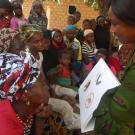
Applications for the 2020 Rx One Health Field Institute are now open! This four-week, field-based experiential summer program in East Africa offers career training for recent graduates or students in medical and veterinary school, as well as early-career health, agriculture, environmental sciences, and conservation professionals.
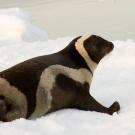
Scientists have linked the decline in Arctic sea ice to the emergence of a deadly virus that could threaten marine mammals in the North Pacific, according to a study from the University of California, Davis.
Attendees Partner to Bring One Health to K-12 Classrooms
On November 2, the 6th annual UC Davis One Health Symposium will bring together veterinarians, physicians, public health officials and scientists at the UC Davis School of Medicine in Sacramento to explore current issues impacting the health of animals, people, plants and the environment.
Students, health professionals unite in support of global One Health Day
UC Davis will join students and health professionals around the world in support of One Health Day with the 6th annual UC Davis One Health Symposium on Saturday, November 2, at the UC Davis School of Medicine in Sacramento.
USAID Award Supports New Project Led by UC Davis One Health Institute
The U.S. Agency for International Development will award up to $85 million over the next five years to the University of California, Davis’ One Health Institute and consortium partners to implement the One Health Workforce—Next Generation project.
The sixth ebolavirus, Bombali virus, has been detected in insect-eating bats in Guinea. In addition to findings reported by researchers earlier this month, scientists from the University of California, Davis, detected the virus in Angolan free-tailed bats roosting inside people’s houses in Guéckedou and Kissidougou.
Genetic Link Found Between Deadly Pathogen and Wild and Feral Cats on Land
Many wild southern sea otters in California are infected with the parasite Toxoplasma gondii, yet the infection is fatal for only a fraction of sea otters, which has long puzzled the scientific community. A study from the University of California, Davis, identifies the parasite’s specific strains that are killing southern sea otters, tracing them back to a bobcat and feral domestic cats from nearby watersheds.
Whether it’s relaxing lakeside, exploring vast forests or hiking through the mountains, the warm weather draws major crowds to some of our favorite outdoor locations. But we’re not the only ones flocking to these locations this summer.
As climate change warms the landscape, it opens a door for some disease-carrying bugs, like ticks and mosquitoes (arthropods, collectively), to march into unchartered territories. Just a few degrees can mean the difference between the presence or absence of some insects in your neighborhood, and can increase how often they reproduce.
TEDMED is a health-focused iteration of the renowned TED conference, celebrating the ideas behind progress in health and medicine through a program called The Hive. Diversity and multi-disciplinary collaboration are at the core of TEDMED's mission to "catalyze a healthier world."
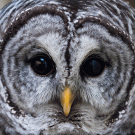
Members of the community are invited to visit the California Raptor Center Spring Open House for a free, fun educational experience. Educational raptors will be on “the fist" -- ask our handlers a question! Lectures on raptor rehabilitation, identification, conservation and adaptations are offered during the day. Visitors can take a self-guided tour of our permanent resident birds and visit the Museum for a hands-on experience. There is no charge for this event and parking is free.
In April 2019, the UC Global Health Institute (UCGHI) welcomes co-vice chairs, Jonna Mazet and Lara Stemple to its Board of Directors.
Jonna Mazet, DVM, MPVM, PhD (UC Davis) and Lara Stemple, JD (UCLA) will serve alongside Anil Deolalikar (UC Riverside), chair of the Board. “We are lucky to welcome co-vice chairs from such different disciplinary and work backgrounds. They will both bring a wealth of knowledge and experience to UCGHI,” said Deolalikar.
Two isolated mountain lion populations in Southern California’s Santa Ana and Santa Monica Mountains are at risk of local extinction, perhaps as soon as within 50 years, according to a study published in the journal Ecological Applications.
The study showed the extinction risk is due to low genetic diversity and mortality that affects the stability of the population. Mountain lion mortality is often caused by humans, but can also result from changes in the environment, such as wildfire and fluctuations in prey density.
Predicting the emergence of highly pathogenic viruses in animals and preventing them from spilling over to humans is the goal of a multi-million-dollar cooperative agreement from the Defense Advanced Research Projects Agency (DARPA) with collaborating researchers at the University of California, Davis; the University of Idaho; and Plymouth University in England.